🌀 The movement reference
| Form | Press or hold | Release or wait | Main thing to read |
|---|---|---|---|
| Cube | Jump from a valid surface | Let the arc finish | Takeoff and landing |
| Ship | Apply upward thrust | Reduce lift; manage descent | Height and momentum |
| Ball | Switch gravity when a valid action is available | Travel toward the other surface | The destination and next contact |
| UFO | Apply a discrete upward impulse | Fall between impulses | The spacing between taps |
| Wave | Travel along one diagonal | Travel along the opposite diagonal | The next corner |
| Robot | Hold to extend a grounded jump | Limit the height of the jump | Ceiling and landing width |
| Spider | Transfer instantly toward the opposite surface | Wait for the next valid action | The landing surface |
| Swing | Reverse gravity during flight | Continue the resulting curved motion | Vertical direction and momentum |
These eight forms are game modes. Classic and Platformer are game types. Classic advances automatically; Platformer adds horizontal movement. Wave and Swing are unavailable as ordinary Platformer modes, so an eight-form reference does not mean every type or browser project offers all eight. The table assumes normal gravity and ordinary form actions; object interactions can add other rules.
Tap-based decisions
Cube, Ball, Spider, and UFO sections often place the next useful action at a specific event: leaving the ground, reaching a valid contact, or choosing another upward impulse. Repeated presses are not interchangeable with a continuous hold.
The important question is whether a new press is available and useful at that moment. A visually frantic section can still be a sequence of distinct actions.
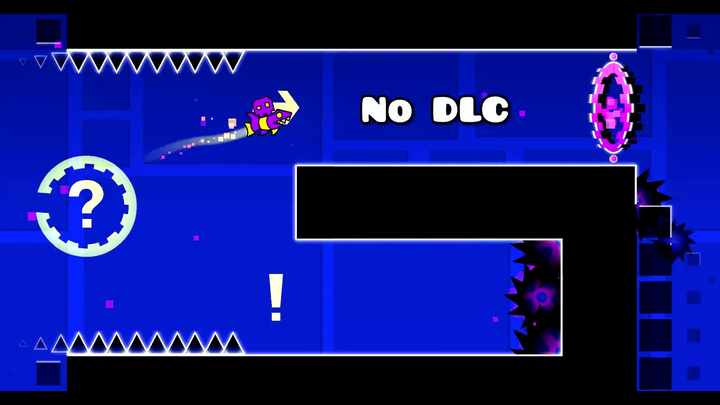
 Geometry Dash single-player portal
Continuous control
Ship and Wave sections ask you to manage what happens between presses. Releasing actively changes the path. Swing adds gravity reversals while motion continues, so the time between switches matters as much as the switches themselves.
Robot sits between these ideas: its jump starts as a grounded decision, and hold duration helps choose the height.
🚪 Learn the handoff, not only the form
A good ship drill can fail to transfer if your cube-to-ship entrance starts at a different height. A familiar wave pattern can feel strange after mini size or inverted gravity. Learn the first action in its real context.
A practical order of study
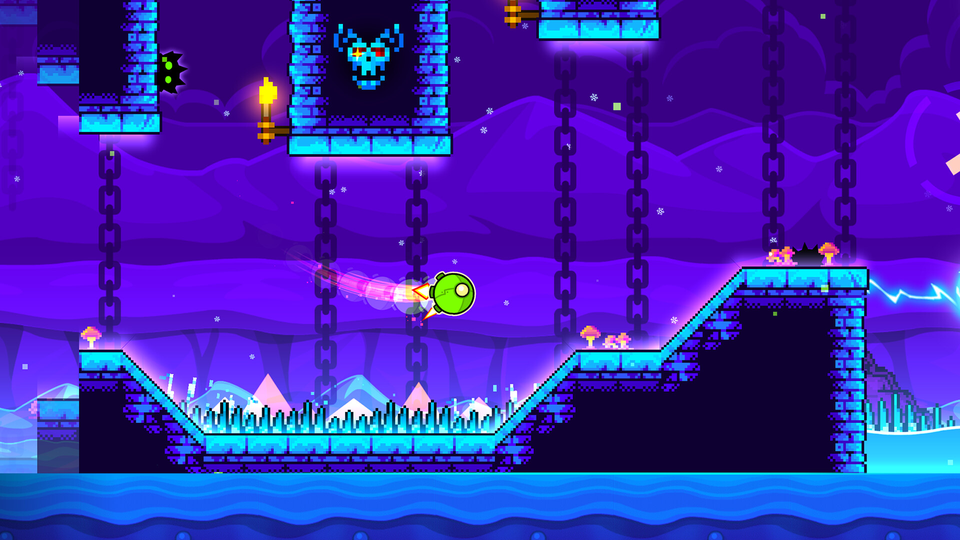
Start with the form causing your current failure. You do not need a separate training plan for all eight before playing a normal level. Read its rule, test the smallest movement, then return to the section that needs it.
Use the controls reference if the action is not reaching the game. Use the portal guide if the action works but the entrance keeps putting you in a bad position.