🤖 Choose the height you need
A Robot jump starts from a valid surface. Holding extends that grounded jump only up to its limit; it is not a way to keep flying indefinitely. Release earlier for a shorter hop, then allow the landing to make the next grounded action available.
A taller jump is not automatically safer. It can hit a low ceiling, overshoot a small landing, or delay the next grounded action. Use the smallest reliable jump that fits the actual route rather than holding as long as possible by default.
Remember the entry conditions
Mini size, gravity, speed, and jump objects can change how the section feels. A ring activation is still a separate object interaction, not simply a longer robot hold. Look at orbs and pads when the route uses one.
The classic browser adaptation does not contain every later form. Use this guide for Robot sections in an edition that includes them, and keep its movement rule distinct from the Cube.
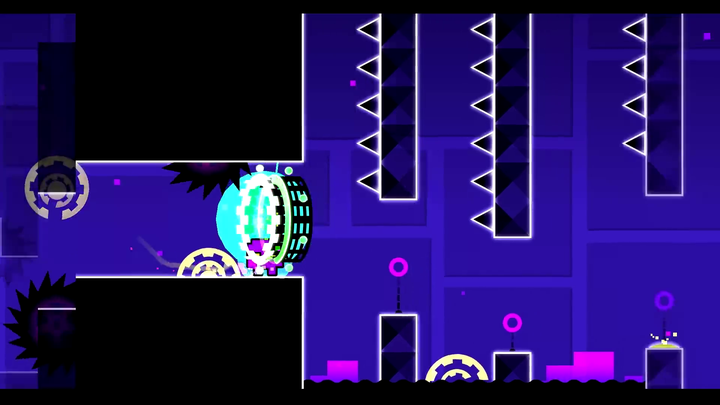
 Geometry Dash robot portal
The three-part plan
Takeoff
Choose where the jump begins relative to the obstacle.
Duration
Choose how long to hold so the path fits beneath any ceiling.
Landing
Check whether the destination leaves enough room for the next action.
Relative jump sketches under the same ordinary conditions. Holding extends a Robot jump only up to its limit.
🧱 Read the roof as well as the floor
A low overhead block can make a short hop the intended solution. Looking only at the spike encourages a long hold that clears the lower hazard but creates an upper collision. Scan the usable vertical space before choosing the input duration.
| Route condition | Input idea to test | What to watch |
|---|---|---|
| Low obstacle, low ceiling | A brief, distinct jump | Whether the apex stays inside the opening |
| Higher landing | A more sustained hold | Whether the icon reaches the surface with a safe approach |
| Small landing before another jump | A controlled duration | How much platform remains after landing |
| Unexpected extra jump | A deliberate release before contact | Whether a held action continues into the next grounded state |
🧪 Compare two holds fairly
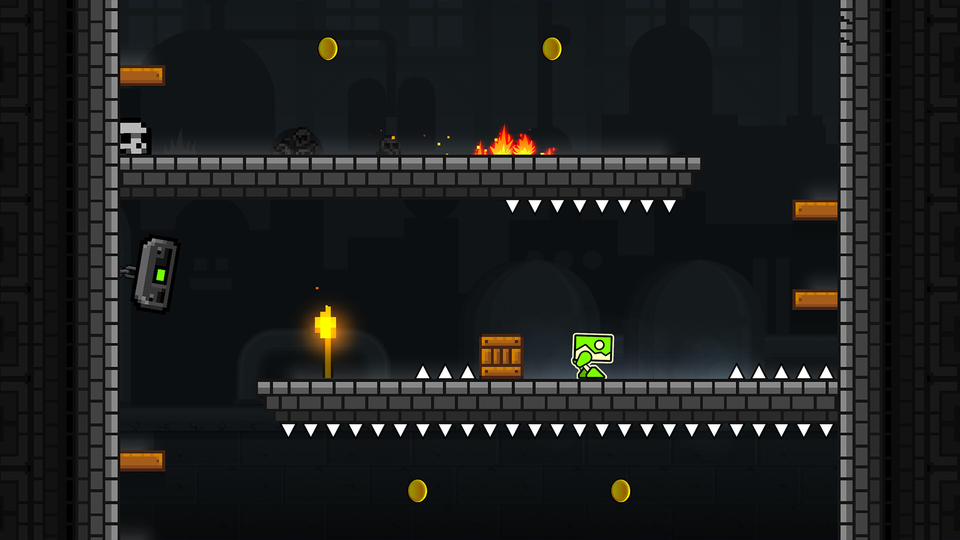
Use the same approach and takeoff cue. First make a short jump, then repeat with a slightly longer hold. Watch the full route: height, travel, landing, and readiness for the next action.
If the takeoff changes on every attempt, you are testing two variables together. Stabilize the cue before deciding which duration fits. This makes a troublesome robot section a readable experiment instead of a collection of lucky jumps.