🔥 Read the label with context
| Rating | Broad expectation | A sensible learning question |
|---|---|---|
| Auto | A route designed to proceed without normal active play | Is this an automatic showcase rather than a timing exercise? |
| Easy / Normal | A gentler introduction to the course’s rules | Can I read the next landing without guessing? |
| Hard / Harder | More demanding patterns or transitions | Which new habit does the stage expect? |
| Insane | A substantial consistency challenge | Can I link the difficult sections? |
| Demon | A high-challenge category with its own subdivisions | Is the specific skill profile a reasonable next step? |
N/A or an unrated label means a difficulty has not been assigned; it does not mean the stage is easy. Official-stage ratings and community ratings also have different contexts. Read the displayed face and reward without turning them into a measured input window.
👿 The five Demon subdivisions
The familiar categories are Easy Demon, Medium Demon, Hard Demon, Insane Demon, and Extreme Demon. They make a broad difficulty range easier to discuss. They still do not tell you whether a stage is mostly wave control, memory, long-form consistency, or difficult transitions.
An Easy Demon is not an easy game level in the everyday sense. The word “Easy” is relative to the Demon category. If early official stages are still inconsistent, the useful next step is usually the mechanic causing those failures.
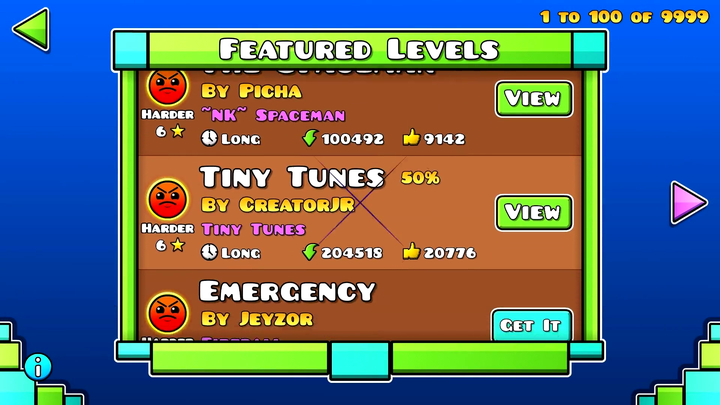
 Geometry Dash Extreme Demon difficulty face
Stars are not a stopwatch
Stars are a reward and rating signal associated with classic levels. Platformer content uses moons. Neither number specifies an exact reaction window or how many attempts you should need.
For a community level, distinguish its difficulty face from its reward and featured status. A visual highlight or elaborate decoration does not tell you whether its hardest action is a ship correction, a wave burst, or a memory sequence. Preview the actual route before choosing it as your next exercise.
🧭 Choose the next level by the gap in your play
If grounded jumps are the problem, more flight-heavy stages will not necessarily fix them. If you can perform each section but fail while linking them, a harder set of isolated obstacles may add frustration without addressing consistency.
| You can do this | But struggle with this | Prioritize |
|---|---|---|
| Clear individual obstacles | Maintain the route through a transition | Portal approaches |
| Recognize the pattern | Repeat the same press timing | Stable timing cues |
| Finish in practice | Complete uninterrupted | Overlapping linked runs |
| Jump well as a cube | Control height during flight | Ship release timing |
Avoid the comparison trap
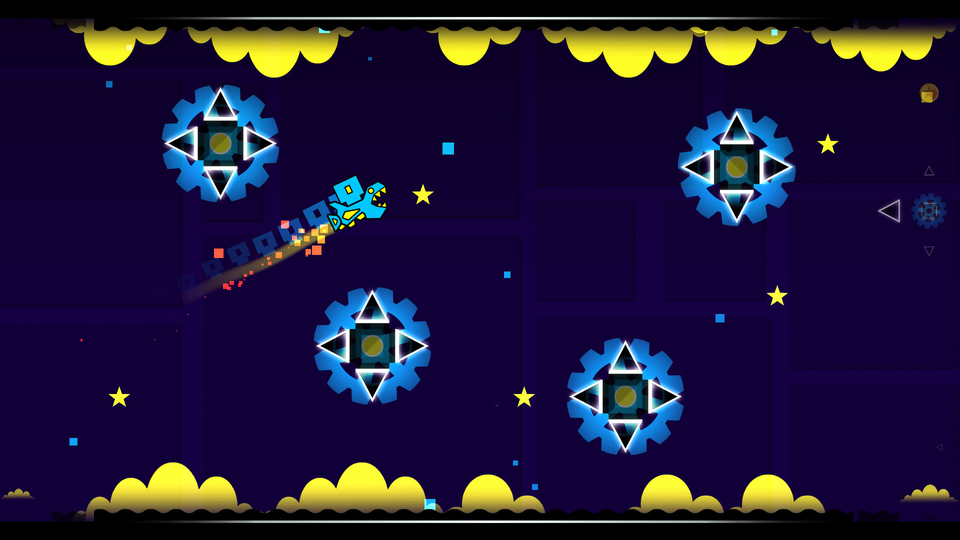
Another player’s attempt total comes with history you cannot see: other levels, an input device, practice time, and familiarity with the mode. Treating their count as your deadline gives you very little practical information.
Your useful comparison is narrower. Does the entry work more often? Can you name the cue? Can you carry the solution from a checkpoint into normal mode? Those questions show where the next improvement belongs.