🔵 Treat the jump sequence as a shape
Do not judge a jump only by the spike directly in front of you. Its landing becomes the start of the next jump. A takeoff that clears one group but lands awkwardly can make the following obstacle feel unfairly tight.
Read the pair: where you leave the surface and where you must be ready again. If a later collision repeats, inspect the jump that set it up. The final failed press may be a consequence of an earlier spacing error.
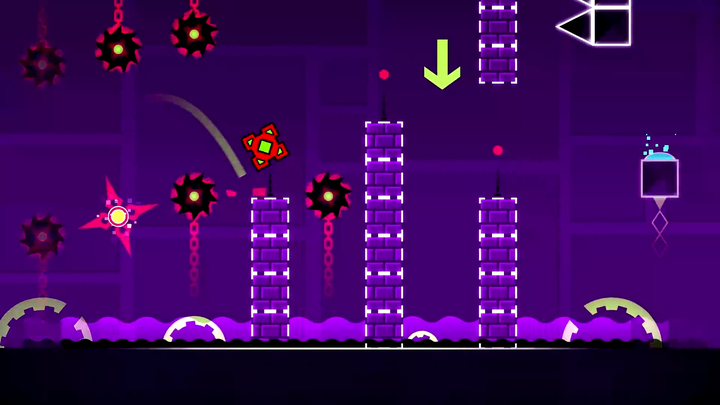
 Geometry Dash Hard difficulty face
🙃 Keep inverted reading familiar
Use the same local-floor idea developed in Dry Out. The upper surface is the floor while gravity is inverted. The action remains a jump away from that surface and a return toward it.
Darkness and decoration can make a familiar obstacle shape harder to identify. Look for the traversable edges. Once you recognize a repeated pattern, keep its successful input sequence steady instead of improvising extra taps because the scene looks different.
A useful section note
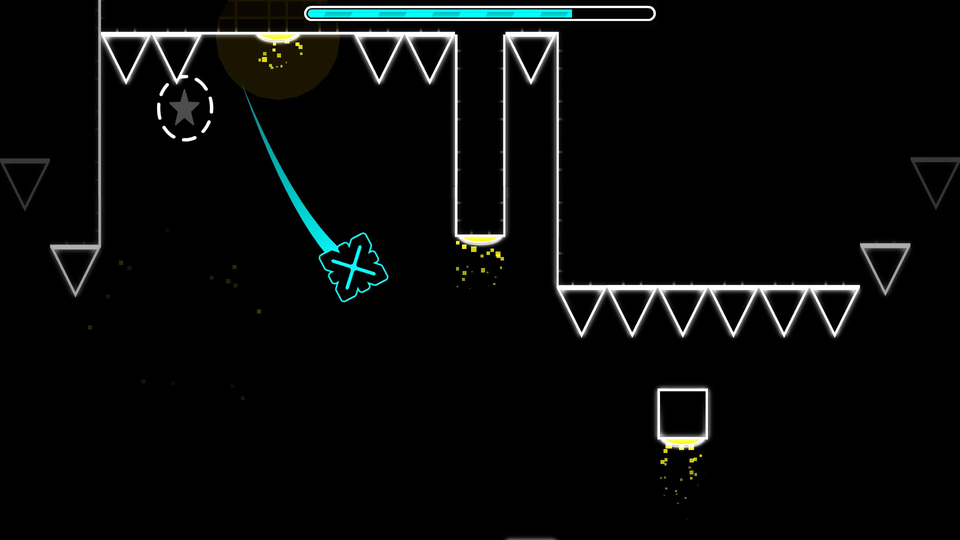
Make the note short enough to remember during play. Include the release if a continuous hold would start an unwanted grounded jump.
🔗 Give the later route enough attention
Locate the first uncertain chain
Use a clear visual landmark rather than a percentage you must watch while playing.
Fix the setup
Check the preceding landing before moving the final jump’s timing.
Repeat the connected chain
A solution should include the first safe landing after the difficult group.
Bring the ending into normal mode
Once the local route is understood, test it from earlier so the full attempt does not depend on a new discovery.
Do not let the opening consume the session
If the opening is reliable but the dark section is not, begin a practice run before the lighting change. Track the solid platform edges into the darker scene, then continue until the next safe landing. That tests the visual handoff instead of replaying only the opening.
Name the late chain by its surfaces: the ledge you land on, the edge where the next jump begins, and the first safe position afterward. Bring that short map into the full run. A note tied to those objects stays more useful than watching the percentage counter approach a personal best.
📌 What improvement looks like here
- The same approach produces the same landing.
- You can identify an inverted obstacle without rethinking the key.
- The next jump begins from a usable position.
- You know the late section before arriving in a best run.
Those observations are more useful than an arbitrary deadline for completion.